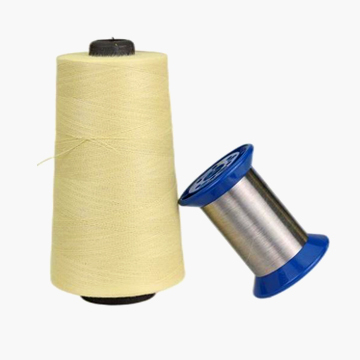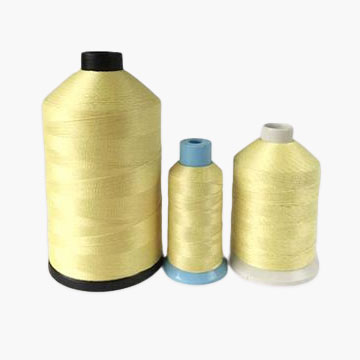
Kevlar® Aramid Fabric
DuPont™ Kevlar®, originally in English as Kevlar, is also translated as Kevira. It is a brand name of an aramid fiber material product developed by the American company DuPont™. The chemical name of the material is “poly(p-phenylene terephthalamide)” with a repeating chemical unit of -[-CO-C6H4-CONH-C6H4-NH-]-; the amide groups attached to the benzene ring are in a para-position, commonly known as fire-resistant fiber.
Kevlar® fibers have extremely high strength. The strength-to-weight ratio is six times that of steel wire, three times that of glass fiber, and twice that of high-strength nylon industrial yarn; its tensile modulus is three times that of steel wire, twice that of glass fiber, and ten times that of high-strength nylon industrial yarn. Kevlar® fibers have a very wide continuous use temperature range and can operate normally for a long time between -196 to 350°C.
The shrinkage at 150°C is zero, and it does not melt at high temperatures of 560°C.
Fiber characteristics:
Linear density: 1.44 g/cm³;
Long-term heat resistance and flame retardancy;
Limiting oxygen index: >28;
Long-term antistatic properties;
Long-term resistance to acid, alkali, and organic solvent corrosion;
High strength, high wear resistance, and high tear resistance;
No molten droplets when exposed to fire, and no toxic gases are produced;
When the fabric surface is burned, it thickens, enhancing sealing performance and does not crack.
Thermal properties:
Long-term use temperature: 180 ℃;
Axial thermal expansion coefficient: -2 × 10^(-6) / K;
Thermal conductivity: 0.048 W(m·K);
Decomposition temperature: 427-482 ℃
Mechanical Properties:
Strength: 3.6 GPa;
Tensile Modulus: 131 GPa;
Elongation at Break: 3 %;
Breaking Strength: 23 g/d
Picture
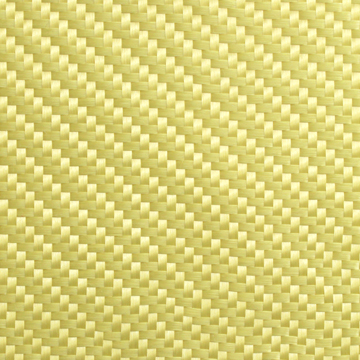
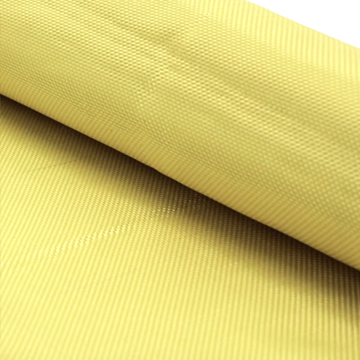
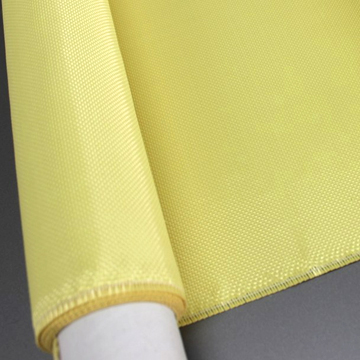
Specifications
| Fibers | Craft | Warp Density | Weft Density | Width | Thickness | GSM |
|---|---|---|---|---|---|---|
| 200D | Plain | 15 (10mm) | 15 (10mm) | 1m | 0.1mm | 60gsm |
| 400D | Plain | 12 (10mm) | 12 (10mm) | 1m | 0.13mm | 100gsm |
| 1000D | Plain | 7 (10mm) | 7 (10mm) | 1m | 0.24mm | 160gsm |
| 1000D | Plain | 9 (10mm) | 9 (10mm) | 1m | 0.26mm | 200gsm |
| 1500D | Plain | 7 (10mm) | 7 (10mm) | 1m | 0.3mm | 240gsm |
| 1500D | Plain | 6 (10mm) | 6 (10mm) | 1m | 0.65mm | 400gsm |
Application Fields and Typical Cases
In the 21st century, Kevlar® laminated sheets combined with steel and aluminum armor have been widely used not only in tanks, armored vehicles, and bulletproof vests, but also in nuclear-powered aircraft carriers and missile destroyers, greatly improving the protection and mobility of these weapons. Kevlar® combined with ceramics such as boron carbide is an ideal material for manufacturing helicopter cockpits and seats.
To enhance the survivability of personnel on the battlefield, there has been increasing emphasis on the development of bulletproof vests. Kevlar® is also an ideal material for making bulletproof vests. Reports indicate that replacing nylon and fiberglass with this material can at least double the protective capability under the same conditions, while maintaining good flexibility and comfortable wear. Bulletproof vests made from this material weigh only 2–3 kilograms, making it easy to move while wearing them, which is why they have been adopted by police and soldiers in many countries.
Today, optical fibers used for transmission also use Kevlar® to form a protective layer, providing good flexibility and protecting the fibers from damage. This is generally referred to as a buffer layer or coating, which, outside the optical fiber but inside the outer sheath, can also be filled in the middle of the cable to enhance mechanical strength.