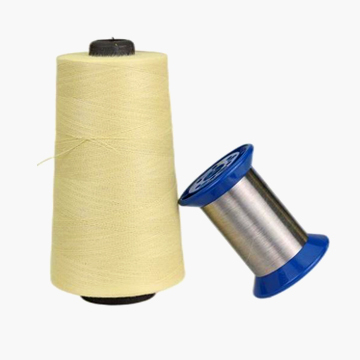
Para-aramid filament sewing thread
Para-aramid filament sewing thread is a high-performance sewing thread made from para-aramid filaments, with core advantages of high strength, high temperature resistance, wear resistance and chemical corrosion resistance. It is specially designed for sewing needs in harsh working conditions or high-end scenarios.
Core Characteristics
High breaking strength: It can withstand high-intensity pulling after sewing, ensuring seams are not prone to cracking and suitable for splicing high-strength materials.
Outstanding high-temperature resistance: It can withstand long-term use at 200-260℃, adapting to sewing processing in high-temperature environments (such as high-temperature setting procedures) and end-use.
Excellent wear and chemical resistance: Not easy to fail due to friction, wear or contact with acids, alkalis and solvents, with a long service life.
Low shrinkage and dimensional stability: Not easy to deform after sewing, maintaining flat and beautiful seams.
Production Process
Raw Material Preparation:
Select high-purity terephthaloyl chloride and para-phenylenediamine as the main raw materials. Through precise proportioning and a special dissolution process, a spinning dope with a certain concentration and specific properties is prepared.
Spinning Process:
The dry-jet wet spinning process is usually adopted. The spinning dope is extruded through spinneret holes and coagulates to form filaments in a coagulation bath. Subsequently, a series of post-treatment processes such as stretching, water washing and drying are carried out to further improve the fiber’s performance and quality.
Twisting into Thread:
Multiple Kevlar aramid filaments are twisted. According to different application requirements, the degree and method of twisting are controlled to make the filaments intertwine and bond tightly, forming Kevlar aramid filament sewing thread with a certain strength and flexibility.
Picture
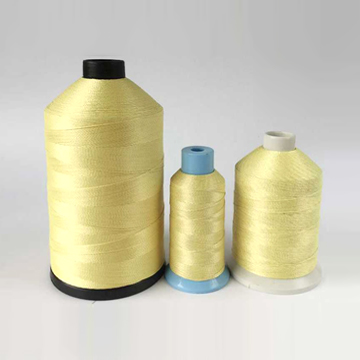
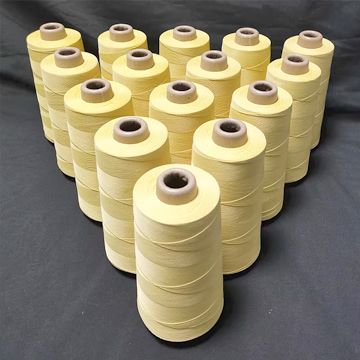
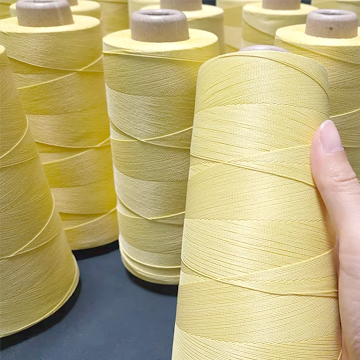
Specifications
| Model | Fracture strength | Diameter | Length/Kilogram | Weight/Roll |
|---|---|---|---|---|
| 200D/2 | 6.5 kgf | 0.2 mm | 21500 m | 200 g |
| 200D/3 | 9 kgf | 0.25 mm | 14000 m | 200 g |
| 400D/2 | 13 kgf | 0.3 mm | 10500 m | 200 g |
| 400D/3 | 19 kgf | 0.35 mm | 7000 m | 200 g |
| 800D/2 | 25 kgf | 0.4 mm | 5200 m | 500 g |
| 800D/3 | 37.5 kgf | 0.45 mm | 3500 m | 500 g |
| 1000D/2 | 32 kgf | 0.5 mm | 4200 m | 500 g |
| 1000D/3 | 48 kgf | 0.55 mm | 2800 m | 500 g |
| 1500D/2 | 48 kgf | 0.55 mm | 2800 m | 500 g |
| 1500D/3 | 72 kgf | 0.6 mm | 1800 m | 500 g |
Application field
Protective equipment: Sewing bulletproof vests, stab-resistant clothing, fire-fighting suits, high-temperature work clothes, etc., ensuring seams have the same protective performance as the main material.
Aerospace: Splicing aircraft interior materials, heat-resistant components around engines, and spacecraft structural fabrics, balancing light weight and reliability.
Industrial fabrics: Sewing high-temperature conveyor belts, filter bags, special canvas, seals, etc., suitable for long-term use under harsh industrial working conditions.
Electronics and electrical engineering: Fixing or sewing motor insulation materials, high-temperature cable sheaths, etc., meeting the temperature resistance and safety requirements of electrical equipment.